The Ideal Weight of a Labrador Retriever
Understanding History, Function, Development, and Condition
General weight charts provide broad population averages. To understand ideal weight, we must understand the Labrador Retriever itself.
Different breeds are built differently, and even within the Labrador breed there can be variation in style and interpretation. Some dogs may appear more refined, show more tuck-up, or lack the dense double coat that is characteristic of correct type. These differences can influence how weight and condition are perceived but let's take a look at a question we get all the time .... What is the ideal weight for my Labrador?
Ideal weight should always be considered in the context of the breed standard — rooted in the Labrador’s history, structure, and purpose.
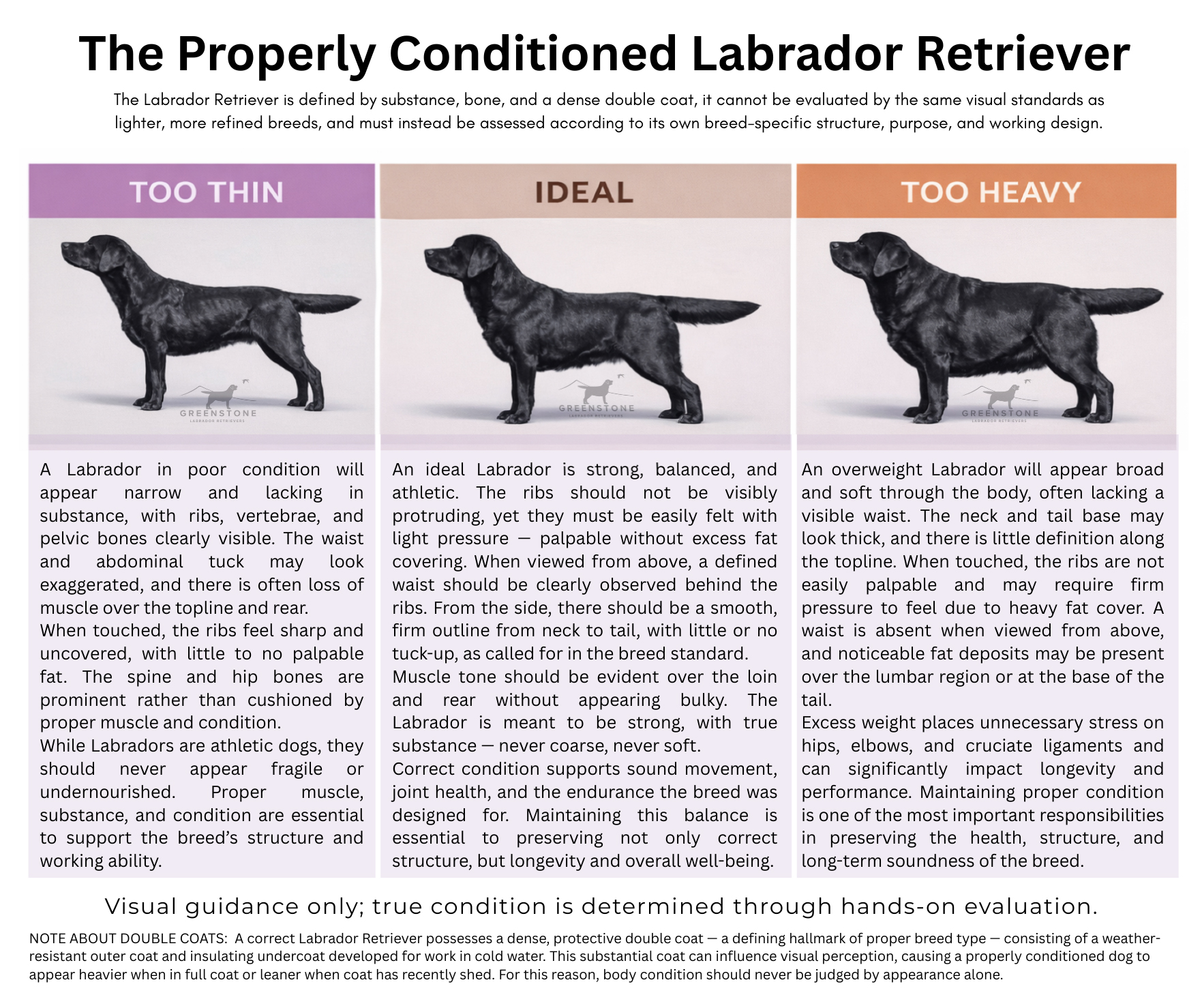
The chart below is to be used as one helpful tool in determining a property weight and condition of a Greenstone Labrador Retriever..
(click on this photo to expand or print)
One Breed, Built for Work
There is only one Labrador Retriever breed.
The Labrador developed from the working water dogs of Newfoundland and was refined in the United Kingdom. These were rugged, functional dogs working alongside fishermen in harsh coastal conditions. They swam in frigid North Atlantic waters to retrieve fish and assist with hauling nets. This was demanding physical labor. They required strength, endurance, and insulation. They needed sufficient bone and substance to power through cold water and current. They required strong shoulders and hindquarters for swimming, and they needed protection from freezing temperatures.
The Labrador’s double coat — a dense, weather-resistant outer coat over a thick insulating undercoat — was essential. It repels water, protects the skin, and retains warmth. That coat also contributes to the dog’s visual depth and substance. A correctly coated Labrador may appear more robust than a thin-coated dog, even when in excellent condition.
The Labrador was never meant to be slight or fragile. It was designed to endure.
Different Emphases Within the Same Breed
Over time, breeders have emphasized different strengths within this single breed. Some lines are developed with greater focus on field endurance and speed. Others place stronger emphasis on breed type and balanced conformation. An analogy from human athletics helps illustrate this naturally. A marathon runner is built for sustained distance — efficient and streamlined. A sprinter carries more explosive muscle. A swimmer often has powerful shoulders and depth through the chest. A gymnast is compact, balanced, and strong.
All are athletes. All are healthy. But their builds reflect the work they are designed to perform.
Labradors are no different.
Lines developed primarily for field performance often resemble the distance runner — lighter-framed and highly efficient in motion. Lines developed with greater emphasis on traditional breed type often carry more natural bone and substance, reflecting the Labrador’s historic working build. Neither is a separate breed. Neither is more correct as a Labrador.
They are different structural expressions within one versatile working dog — and those differences naturally influence weight.
Condition Is the True Measure
The scale measures pounds. It does not measure muscle tone, bone density, coat, or conditioning.
A Labrador that swims, trains, retrieves, and lives an active life develops muscle mass. Muscle weighs more than fat. A well-conditioned dog may weigh more than expected while remaining in excellent health.
When evaluating your Labrador, use your hands and your eye. You should be able to feel the ribs without pressing hard. There should be a visible waist when viewed from above. The dog should feel firm and athletic, not soft.
Excess fat obscures structure. Insufficient conditioning weakens it.
A correctly conditioned Labrador feels balanced, capable, and strong — never overloaded or underdeveloped.
Growth Is Not the Same as Maturity
Young Labradors require special consideration.
Most puppies reach their approximate adult height by about twelve months of age. At that stage, the frame is largely established. However, full physical maturity — including chest depth, muscle development, head substance, and overall body fill — continues between 18 and 24 months, sometimes longer in larger males.
During adolescence, it is entirely normal for a Labrador to appear leaner or less finished than it will as a mature adult.
Growth does not occur in a straight line. Young dogs often go through spurts. During those periods, appetite may increase as the body demands more fuel. At other times, growth slows, appetite naturally decreases, and less food is required.
Attentive ownership is essential during this stage.
Feeding should be responsive rather than automatic. Adjust portions based on body condition and development, not routine alone. A growing Labrador may require more for a period of time — and then less as development steadies.
It is also during this period that growth plates are still closing. Maintaining a lean, balanced condition supports joint health and long-term structural soundness. Excess weight during development places unnecessary strain on hips and elbows.
Balanced development builds durability.
Ultimately, responsible feeding means evaluating the individual dog — not simply following a fixed measurement. When you learn to assess condition thoughtfully, you will make appropriate adjustments at the right time.
The Preservation Perspective
As preservation breeders, our responsibility is not to produce dogs that match a chart.
Our responsibility is to preserve correct type, structural integrity, functional strength, and long-term health.
Ideal weight is the weight that allows the Labrador to function as the athletic, enduring working dog it was designed to be — strong enough to work, sound enough to move efficiently, and durable enough to age well.
The scale is a reference.
The dog in front of you is the measure.
Thoughtful Weight Management and Condition
Weight management in a Labrador is best approached with steadiness rather than extremes.
Carrying excessive body fat over time can place added stress on joints and may affect long-term mobility. At the same time, growing puppies require consistent nutrition to support proper bone development, muscle growth, and overall health. They should not be restricted in an effort to keep them looking especially lean.
Labradors vary naturally in bone and substance. Puppies from more substantial lines may appear more robust than lighter-framed dogs of the same age. That alone does not indicate a problem.
The goal is to support the dog’s health at every stage — providing adequate nutrition during growth, maintaining muscle as they mature, and preventing unnecessary strain as they age.
Balance, consistency, and thoughtful observation serve the breed best.
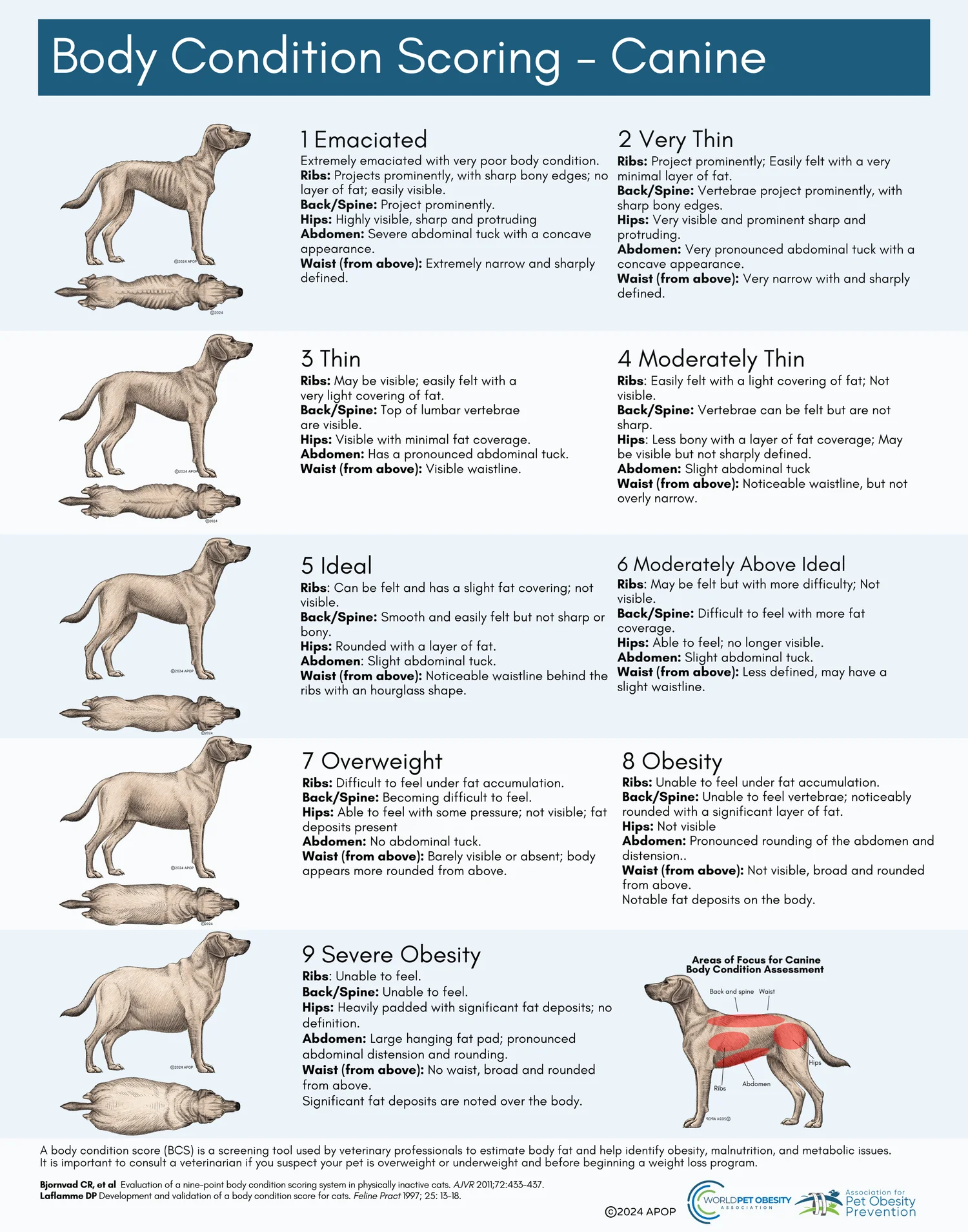
The chart below is to be used as one helpful tool in determining a healthy Body Conditioning Score.
(click on this photo to expand or print)